Tuesday, March 24, 2009

MissTaken - Film review

This short film, MissTaken, is only 5 minutes long. It is professionally shot, delightfully acted and directed, and elevates the genre of Tibetan diaspora filmmaking to a new level. It is the story of Kunga (played by Tibetan actor and comedian Sonam Wangdu of Phun Anu Thanu fame), who takes a cab from Manhattan to his Brooklyn apartment. He and the cab driver (played by budding actor and seasoned photographer Lobsang Choephel) strike up a conversation that unfolds in unexpected ways leading up to the climax at the end. It is a short Tibetan story set in the center of New York City, about human relationships, and interconnection and interdependence - and anyone who knows how small the exile Tibetan world can be will immediately relate to the strange coincidence at the heart of the story.

It is very impressive how the filmmaker is able to tell this complex story in 5 minutes using non-linear narrative to keep the viewer in suspense till the surprise ending. In addition to wonderful filmmaking, this short film showcases excellent performances by the three main actors. Lobsang Choephel, who plays the taxi driver and is a newcomer to Tibetan cinema, is a wonder. We already know and admire Sonam Wangdu's interpretations and performances. The girlfriend impresses as the suspicious and super-bossy girl-friend; however, it’s a shame we only get to see her uni-dimensionally. It would have been a nice change to see her smile at least once, but she maintains her tough exterior never once letting up. But it’s a short film, so perhaps there wasn't much room and time to explore the full range of her emotions and personality.

Sonam Wangdu impresses but this is no surprise because he is a seasoned actor, and after seeing his performance in Phun Anu Thanu and Dreaming Lhasa, we know what he is capable of. How can we forget his virtuoso performance in his short role as the travel agent in Dreaming Lhasa? Sonam’s character captures the agony of an alienated lover very well. But Lobsang Choephel is a discovery; he doesn’t just play a taxi driver, he becomes the taxi driver. He needs make no beginner's excuse; his performance is understated, assured and supremely convincing.

Over all, it’s a wonderful story -taut, original and compelling- written by Thupten Nyima and Sonam Wangdu. There are no extraneous parts; everything is there for a purpose and builds up to the climactic ending. The film has lovely original music and songs by Tendor (of SFT). The filmmaker Thupten Nyima himself sings one song, and very beautifully.

You can tell that the short film was made on a shoe-string budget. If they can make such a good film on pittance, imagine what they could accomplish with more resources and time at their disposal. Hats off to all involved in the making of this short film. We hope you will continue to entertain and inspire us.

Please note:

This film is in the running to be among the top 10 short films.
http://www.babelgum.com/html/clip.php?clipId=3005437

Monday, March 23, 2009

South Africa bars Dalai Lama from peace conference

In this Sunday, March 8, 2009, file photo, Tibetan leader, the Dalai Lama, left, AP – In this Sunday, March 8, 2009, file photo, Tibetan leader, the Dalai Lama, left, greets the crowd gathered …

JOHANNESBURG – South Africa barred the Dalai Lama from a peace conference in Johannesburg this week, hoping to keep good relations with trading partner China but instead generating a storm of criticism.

Friday's peace conference was organized by South African soccer officials to highlight the first World Cup to be held in Africa, which South Africa will host in 2010.

But because the Dalai Lama isn't being allowed to attend, it is now being boycotted by fellow Nobel Peace prize winners retired Cape Town Archbishop Desmond Tutu and former president F.W. de Klerk as well as members of the Nobel Committee.

"It is disappointing that South Africa, which has received so much solidarity from the world, doesn't want to give that solidarity to others," Nobel Institute Director Geir Lundestad told The Associated Press in Oslo, referring to the decades-long fight against apartheid.

An eclectic mix of Nobel laureates, Hollywood celebrities and other dignitaries are coming to discuss issues ranging from combating racism to how sports can unite people and nations.

But Thabo Masebe, spokesman for President Kgalema Motlanthe, said a high-profile visit by the Tibetan spiritual leader would have distracted from the conference's focus.

"South Africa would have been the source of negative publicity about China," he said Monday. "We do value our relationship with China."

South Africa is China's largest trading partner on a continent in which China is heavily and increasingly involved.

Tamu Matose, a spokeswoman for Tutu, told the AP that Tutu would not attend "because of the Dalai Lama issue." Tutu was quoted Sunday as calling the barring "disgraceful."

"(South Africa) should admit anyone with a legitimate and peaceful interest and should not take political decisions on who should, and who should not, attend," de Klerk said Monday, announcing he also would skip the conference.

The Norwegian government said it "regrets" the South African decision, and was considering whether to withdraw.

However, the South African Communist Party backed the move, saying March was a particularly sensitive time for a visit.

Last week marked the one-year anniversary of anti-government riots in Lhasa, Tibet's regional capital, and 50 years since the Dalai Lama escaped into exile in India after Chinese troops crushed a Tibetan uprising.

China claims Tibet as part of its territory, but many Tibetans say Chinese rule deprives them of religious freedom and autonomy. Beijing accuses the Dalai Lama of pushing for Tibetan independence and fomenting anti-Chinese protests.

South Africa decided last month to refuse to issue an official invitation, without which, Masebe said, the Dalai Lama cannot visit.

Masebe said the spiritual leader had been welcomed twice previously in South Africa and would be welcome again in the future — but "not now, when the whole world is looking at South Africa."

Beijing, an ally when South Africa's now-governing African National Congress was a liberation movement, and Pretoria have diplomatic ties stretching back a decade and an economic relationship based on trade as well as aid.

China's exports to Africa last year rose 36.3 percent from 2007 to $50.8 billion, while imports of African goods rose 54 percent to $56 billion, according to customs data reported by Xinhua, the Chinese state news agency.

Critics say China's investment in and aid to Africa, ranging from building presidential palaces and sports stadiums to rail and road projects, aims to secure access to the continent's natural resources.

African governments, though, are eager for the funds and counting on continued Chinese investment despite the global economic meltdown.

Samdhong Rinpoche, the prime minister of the Tibetan government-in-exile, said South Africa was under pressure from Beijing and its decision to bar the Dalai Lama was a business matter.

"South Africa is a newly emerging country and China is giving it considerable economic resources so it is understandable," he said Monday in Dharmsala, India. "Every country has to protect its economic and political interests."

Masebe insisted that his government was not bowing to pressure from China.

"We make our own decisions," he said.

Masebe said if conference organizers had talked with officials beforehand, they would have been advised to exclude the Dalai Lama and the controversy could have been avoided.

But Kjetil Siem, chief executive officer of South Africa's Premier Soccer League, said the Dalai Lama was invited in a routine way along with other Nobel laureates.

"When it comes to peace conferences ... it has nothing to do with the government," Siem said.

Siem said the conference was a chance to show what South Africa has accomplished. Soccer was once as segregated as the rest of South African society, with four race-based leagues. Today, the nation is proudly united behind the upcoming World Cup.

The controversy over the Dalai Lama shows the peace conference is "more needed than ever," Siem said.

___

Associated Press writers Ashwini Bhatia in Dharmsala and Malin Rising in Stockholm contributed to this report.

Situation in Ragya tense, exiles mourn

Situation in Ragya tense, exiles mourn
Phayul[Monday, March 23, 2009 18:39]
By Kalsang Rinchen

Dharamsala, March 23 – The situation in Ragya remains tense as around hundred Tibetans were arrested yesterday following what Xinhua, the Chinese state media, describes as an ‘attack’ on police station and exile right groups call mass protests after a reported suicide of a young monk due to Chinese torture.

Tenzin Choeying, the president of Students for a Free Tibet, India, said the reports appearing in Chinese state media are "blatant lies aimed at diverting the world media attention from the death of an innocent monk under Chinese atrocities."

"The whole of Tibet is locked down, with journalists having no access to Tibetan areas. The information that the journalists sitting in Beijing get are the lies churned out in Chinese state media like Xinhua which says the Tibetan monk did not commit suicide."

Thousands of Tibetan residents of Ragya in Machen County rose up against the authorities Saturday after a 28 year old monk of Ragya monastery reportedly killed himself by jumping into Machu river.

Sources told the Dharamsala based Tibetan Centre for Human Rights and Democracy that leaflets and posters were circulated containing messages that read, "It is better to die for Tibet and her people than being duped by the monetary rewards of the Chinese government".

The Centre said, citing sources that Tashi Sangpo who committed suicide on Saturday was “severely subjected to harsh beatings and inhumane torture”.

Tashi Sangpo was born in Gartse Village in Kaba Sum-dho County, Tsolho "Tibet Autonomous Prefecture" ("TAP"), Qinghai Province. His father's name was Dolma Kyap and mother's name was Phagdron. He joined Du Kor House, Ragya Monastery in his early years and before moving to She-rig Norling House in Ragya Monastery.

Meanwhile, exile Tibetans and foreign supporters carried out a candle light vigil here today to mourn Tashi's death and express solidarity with the Tibetans in Ragya.

Click here for an updated report with pictures of the 6 monks of Lutsang monastery who were not among the 103 monks earlier released after days of patriotic reeducation. The 6 are still held under custody, according to the latest information.

Sunday, March 22, 2009

Tibetans attack police station, 93 monks arrested

Tibetans attack police station, 93 monks arrested


BEIJING – Hundreds of Tibetans attacked a police station and government officials in northwestern China despite heightened security, prompting the arrests Sunday of nearly 100 monks, state media reported.

Six of those arrested for alleged involvement in the attack were caught by police while 89 others turned themselves in, according to the official Xinhua News Agency. All but two were monks, it said.

The protest appeared to be in response to the disappearance of a Tibetan who escaped from police custody in Qinghai province, Xinhua said.

According to a Tibetan exile, the protest involved as many as 2,000 people and was sparked by the apparent suicide of a monk being investigated for unfurling a Tibetan flag.

Xinhua said several hundred people — including nearly 100 monks from the Ragya Monastery — attacked the police station in Ragya, a township in the Tibetan prefecture of Golog, on Saturday, assaulting policemen and government staff.

Some officials were injured slightly in the assault, Xinhua said, without elaborating.

A man who answered the phone at Qinghai's public security department said he had not heard about the attack or the arrests. Phone calls to other police departments and government offices in the area rang unanswered.

The violence is the latest known incidence of unrest following a bomb explosion Monday in an unoccupied police station in predominantly Tibetan Ganzi prefecture in Sichuan province. The explosion shattered the building's windows but no injuries were reported.

In February, Tibetan advocacy groups said a thousand monks gathered at a monastery in Sichuan province's Aba county to protest a ban on celebrating a traditional prayer festival called Monlam. One monk doused himself with gasoline and set himself ablaze.

The violence on Saturday began after a man accused of supporting Tibetan independence escaped from police custody and went missing, Xinhua said.

It cited authorities as saying the man fled from the Ragya police station after asking to go to the washroom, prompting a manhunt. It cited a witness as saying he was seen swimming in the Yellow River.

A former resident of the area who now lives in Dharmsala, India, said the protesters were angry because they believed the man, a 28-year-old monk named Tashi Sangpo, jumped in the river to commit suicide after fleeing.

"When Tashi was being interrogated by the officials, he asked their permission to go to the toilet. He then went out and jumped into the Yellow River," the source said on condition of anonymity, citing fear of reprisals against his family still living in China. "The dead body is yet to be found."

The exile, who said he received the information from people in Ragya, said 500 monks from the monastery protested outside the local administration office and the group swelled to about 2,000 as others from the village joined.

He said Tashi Sangpo was being investigated by police because he unfurled a Tibetan flag on the roof of the monastery on March 10, the anniversary of the start of a 1959 abortive Tibetan revolt against Chinese rule, and distributed pamphlets on the street urging unified protests against Chinese rule. The Tibetan flag is banned in China.

It was difficult to independently verify the account because government departments could not be reached Sunday. Communication is also spotty in the areas and residents usually will not talk for fear of official retaliation.

Dharmsala is the seat of the Dalai Lama's self-proclaimed government-in-exile and the destination of many Tibetans who flee China.

Security in Tibetan areas has been tightened in recent weeks as Beijing tried to head off trouble ahead of sensitive anniversaries this month. March 14 marked the one-year anniversary of anti-government riots in Lhasa, Tibet's regional capital, while March 17 marked 50 years since the Dalai Lama escaped into exile in India after Chinese troops crushed the Tibetan revolt.

China claims Tibet has always been part of its territory, but many Tibetans say the Himalayan region was virtually independent for centuries and that Beijing's tight control is draining them of their culture and identity.

___

Associated Press writer Ashwini Bhatia in Dharmsala, India, contributed to this report.

In this April 6, 2008 file photo, Tibetan monks practice debating in Longwu AP – In this April 6, 2008 file photo, Tibetan monks practice debating in Longwu Monastery in Repkong, western …

Saturday, March 21, 2009

Monk kills self in Ragya, residents protest

Monk kills self in Ragya, residents protest
Phayul[Saturday, March 21, 2009 17:25]
By Kalsang Rinchen

Tashi Sangpo, a monk of Ragya monastery threw himself in Machu river today after banned Tibetan national flag and leaflets were allegedly found in his room, photo/wokar.net
Dharamsala, March 21 – A Tibetan monk of Amdo Golok Ragya monastery in Gyulgho township (Ch: Lajong), Machen county, Qinghai, committed suicide by jumping into Machu river today around 3.30 PM (Beijing time), a source residing here with contacts in Tibet told the Voice of Tibet radio service.

The monk was identified as Tashi Sangpo, aged 28, the source said.

Machu river, into which Tashi Sangpo threw himself earlier today. The Ragya monastery is seen in the background, March 21, 2009/photo/wokar.net
The monastery has remained sealed and been under constant patrol of Chinese forces since March 10 this year when leaflets containing political messages were circulated and a huge Tibetan national flag hoisted atop the main prayer hall of the monastery. Several monks of the monastery were detained in the monastery which has since been completely locked down.

Security forces claimed to have found a Tibetan national flag and political leaflets from Tashi’s room, the source said.

Tashi Sangpo sneaked out of the security forces’ sight by seeking to go to the toilet, according to the source, a former resident of Ragya, who said Machu River is not very far from the monastery.

At the time of this report going online, Tashi’s death has already sparked a strong anti China protest in Ragya where Tibetans are taking to the streets with the banned Tibetan national flag and banners, chanting slogans such as “independence for Tibet, long live Dalai Lama.”

Friday, March 20, 2009

Rare footages show China’s brutality on Tibetan protestors

Rare footages show China’s brutality on Tibetan protestors
Phayul[Friday, March 20, 2009 19:27]
By Phurbu Thinley

Dharamsala, March 20: Tibet’s Government in exile Friday released, what it calls, rare video footages showing Chinese paramilitary police resorting to extreme brutality on Tibetan protestors after last year’s March unrest against Chinese rule.

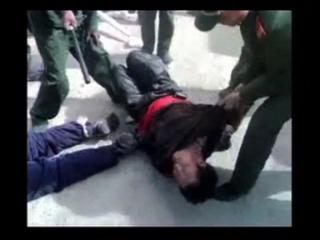
Still image from the footage shows Chinese police beating Tibetan protestors as they lay down handcuffed and tied
One of the three footages from a combined video release, which was screened at a press conference here today, showed Chinese police beating several Tibetans captives as they lay down handcuffed and tied.

“This is one of the rare footages of Chinese police beating Tibetans who participated in the massive and widespread protests that erupted throughout Tibet since 10 March 2008,” said the Department of Information and International Relations (DIIR) of the Central Tibetan Administration in its press statement.

“We are told that these beating of protestors took place in or near Lhasa after 14 March 2008,” the statement added.

Thupten Samphel, information secretary, and Sonam N. Dagpo, international relations secretary, of the DIIR, presided over the press conference.

Describing the footages as being “very disturbing”, Samphel said the acts of brutality violated the “international norms regarding treatment of captives.”

Death of Tendar

File photo of Tendar. He succumbed to his injuries on 19 June, 2008.
A second footage is of a young Tibetan named Tendar, who succumbed to his injuries after he was brutally beaten and tortured by Chinese police officials.

Tendar, a staff in the China Mobile company, met his evil fate on March 14, 2008, after he tried to stop Chinese authorities from beating a lone monk while on his way to his office.

Tendar later suffered inhumane treatments at the hands of Chinese authorities, DIIR statement said.

According to the press statement, Tendar was “fired at, burned with cigarettes butts, pierced with a nail in his right foot, and severely beaten with an electric baton.”

The footage showing the “wounds and the bruise marks visible on his body is a testimony of the brutality he was subjected to by the Chinese authorities,” the statement said.

Tendar was further “denied basic medical care” at the military hospital and was later shifted to the TAR (Tibetan Autonomous Region) People’s Hospital in Lhasa.

Tendar was “denied basic medical care” at Chinese military hospital and was later shifted to the TAR People’s Hospital. He died due to his injuries on 19 June, 2008.
Doctors at the hospital removed “about 2.5 kgs of his body part” in order to clean out the “rotten wounds” caused by prolonged delay in medical treatment.

“Due to covering his wounds with polythene, his wounds began to rot as clearly seen from the footage,” the press statement said.

According to the statement, despite efforts made by his family in meeting huge medical expenses, doctor’s at the people’s hospital failed to bring improvement to Tendar’s ailing body.

He died due to his injuries on June 19, 2008.

When his corpse was offered to the vultures according to the tradition, the statement said a nail was found in his right foot.

Brutality under “virtual martial Law”

Third footage shows the heavy Para-military presence in Lhasa in the run up to the 50th Anniversary of March 10 Tibetan National Uprising this month.

“Lhasa and all other areas of Tibet still remain under virtual martial law,” the exile government said in the statement.

After unrest erupted in March 2008, Beijing swiftly poured more troops into TAR and Tibetans areas in surrounding provinces to smother any protests.

The exile Tibetan government says about 220 Tibetans have died, over 1294 have been seriously injured and more than 1000 have disappeared since the crackdown last year. It says over 5600 people have been arrested and 290 are sentenced so far.

Ahead of the 50th anniversary of the failed uprising that sent the Dalai Lama into exile, paramilitary police and soldiers swarmed cities and villages in Tibet to quell possible repeat of last year’s unrest.

China has repeatedly denied the use of torture in Tibet, and has maintained that Tibet has remained relatively calm in recent months.

In November 2008, the Chinese Foreign Ministry rejected the U.N. panel’s report on the widespread use of torture by Chinese police, calling the report as “untrue and slanderous” and accused the committee members as being “prejudiced” against China.

However, the DIIR’s press statement says, the stunning footages received from Tibet “testify to what is truly happening in Tibet as recently as 2008.”

Following last year’s unrest and the crackdown that followed, Dagpo said, Chinese authorities in Tibet continued resorting to “brutal beatings and torture of the captive Tibetans.”

“We are waiting to receive more such footages in future,” Dagpo said, responding to a media inquiry during the press conference held here at the premises of the Tibetan Government-in-exile.


Watch Video: China’s Brutality in Tibet Exposed.

Wednesday, March 18, 2009

Nun arrested for solo protest in Kardze

Phayul[Wednesday, March 18, 2009 18:33]
Dharamsala, March 18 - A Tibetan nun was severely beaten before facing arrest four days before the 50th Tibetan national uprising day, Tibetan Centre for Human Rights and Democracy said, citing a source.

Lobsang Khandro, 21, a nun from Gema Dra-wok Nunnery in Thing-ka Township, Kardze County, Kardze "Tibet Autonomous Prefecture" ("TAP"), Sichuan Province carried out a solo protest march on the morning of 6 March 2009.

Khandro walked from Takchu Bridge to Kardze government headquarter. Sources said she carried pamphlets, political literature on Tibet and some prayer flags. She shouted slogans such as "No Freedom in Tibet", "Tibetan People Rise Up, Rise Up", "Long Live the Dalai Lama" and "Chinese Authorities Release all Political Prisoners", according to the centre.

The Chinese security personnel rushed in five police vans and beat her severely before taking her to a new detention centre build near the government hospital in Kardze.

Relatives visiting her were turned away by the authorities who told them that she had committed a serious crime and deserves to die.

"If she has involved in this kind of activity, there is no other way but to die. She has committed a serious offense and crime. There is nothing left for all of you to inquire about. Moreover, all of you must not contact the outside world on this matter", the source told TCHRD quoting the authorities.

The Gema Dra-wok Nunnery is situated at a distance of 16 kilometers from Kardze County en route to the sacred pilgrimage site, Khawa Karpo.

Nuns of Gema Dra-wok Nunnery participated in a mass uprising last year during the Tibet unrest and five nuns are still serving prison terms, said TCHRD.