| Phayul[Friday, April 03, 2009 14:10] |
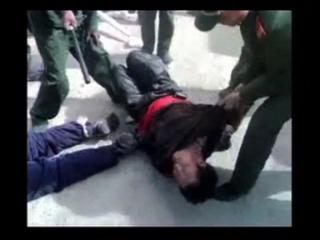
By Kalsang Rinchen  The banner reads "appealing to the court to conduct fair judicial proceedings in accordance with the law" The monks held a large banner with wordings that appealed to the court for fair judicial proceedings for Tibetan protesters. The monks who began the sit-in around 8AM (Beijing Time) were reportedly taken away by the local Public Security Bureau (PSB) officers, said the centre that monitors human rights situation in Tibet, adding that their current whereabouts are not known. In another incident, two nuns of Dragkar Nunnery in Kardze were arrested on March 24. Yankyi Dolma and Sonam Yangchen staged a peaceful protest at the main square of the market in Kardze county around 3PM (Beijing Time), calling for the ‘return of the Dalai Lama to Tibet,’ ‘human rights in Tibet’ and 'religious freedom in Tibet'.  Yankyi Dolma (TCHRD photo) Around 7 PM in the evening, security forces stormed into Yangkyi’s home roughing up the portrait of the Dalai Lama and ‘rebuked the family members for being supporters of ‘separatist forces’. Two Chinese security officials summoned her brother Tsangyang Gyatso to the Kardze County government headquarters the following day (March 25), the centre said, adding that there is no information about what happened thereafter. Yangkyi Dolma was born to Hormeytsang Dargay (father) and Pema Khando(mother) in Roltsa Township, Kardze County, Kardze “TAP” Sichuan Province. Apart from sporadic incidents of protests a major civil disobedience movement is gaining momentum in Kardze with farmers continuing to defy authorities’ orders to till their farmland in protest against China’s repression, the centre said. According to sources, the local Chinese authorities in Drango County in Kardze have given ultimatum to the Tibetan farmers to till their farmland before 11 April failing which their farmland will be confiscated by the government. Since March 10, around 28 known incidents of protests were reported from Kardze alone with arrests of around 60 Tibetans, the center said, adding that many other protests, beatings and arrests went unaccounted for due to strict control on the flow of information. |


JOHANNESBURG – South Africa barred the Dalai Lama from a peace conference in Johannesburg this week, hoping to keep good relations with trading partner China but instead generating a storm of criticism.
Friday's peace conference was organized by South African soccer officials to highlight the first World Cup to be held in Africa, which South Africa will host in 2010.
But because the Dalai Lama isn't being allowed to attend, it is now being boycotted by fellow Nobel Peace prize winners retired Cape Town Archbishop Desmond Tutu and former president F.W. de Klerk as well as members of the Nobel Committee.
"It is disappointing that South Africa, which has received so much solidarity from the world, doesn't want to give that solidarity to others," Nobel Institute Director Geir Lundestad told The Associated Press in Oslo, referring to the decades-long fight against apartheid.
An eclectic mix of Nobel laureates, Hollywood celebrities and other dignitaries are coming to discuss issues ranging from combating racism to how sports can unite people and nations.
But Thabo Masebe, spokesman for President Kgalema Motlanthe, said a high-profile visit by the Tibetan spiritual leader would have distracted from the conference's focus.
"South Africa would have been the source of negative publicity about China," he said Monday. "We do value our relationship with China."
South Africa is China's largest trading partner on a continent in which China is heavily and increasingly involved.
Tamu Matose, a spokeswoman for Tutu, told the AP that Tutu would not attend "because of the Dalai Lama issue." Tutu was quoted Sunday as calling the barring "disgraceful."
"(South Africa) should admit anyone with a legitimate and peaceful interest and should not take political decisions on who should, and who should not, attend," de Klerk said Monday, announcing he also would skip the conference.
The Norwegian government said it "regrets" the South African decision, and was considering whether to withdraw.
However, the South African Communist Party backed the move, saying March was a particularly sensitive time for a visit.
Last week marked the one-year anniversary of anti-government riots in Lhasa, Tibet's regional capital, and 50 years since the Dalai Lama escaped into exile in India after Chinese troops crushed a Tibetan uprising.
China claims Tibet as part of its territory, but many Tibetans say Chinese rule deprives them of religious freedom and autonomy. Beijing accuses the Dalai Lama of pushing for Tibetan independence and fomenting anti-Chinese protests.
South Africa decided last month to refuse to issue an official invitation, without which, Masebe said, the Dalai Lama cannot visit.
Masebe said the spiritual leader had been welcomed twice previously in South Africa and would be welcome again in the future — but "not now, when the whole world is looking at South Africa."
Beijing, an ally when South Africa's now-governing African National Congress was a liberation movement, and Pretoria have diplomatic ties stretching back a decade and an economic relationship based on trade as well as aid.
China's exports to Africa last year rose 36.3 percent from 2007 to $50.8 billion, while imports of African goods rose 54 percent to $56 billion, according to customs data reported by Xinhua, the Chinese state news agency.
Critics say China's investment in and aid to Africa, ranging from building presidential palaces and sports stadiums to rail and road projects, aims to secure access to the continent's natural resources.
African governments, though, are eager for the funds and counting on continued Chinese investment despite the global economic meltdown.
Samdhong Rinpoche, the prime minister of the Tibetan government-in-exile, said South Africa was under pressure from Beijing and its decision to bar the Dalai Lama was a business matter.
"South Africa is a newly emerging country and China is giving it considerable economic resources so it is understandable," he said Monday in Dharmsala, India. "Every country has to protect its economic and political interests."
Masebe insisted that his government was not bowing to pressure from China.
"We make our own decisions," he said.
Masebe said if conference organizers had talked with officials beforehand, they would have been advised to exclude the Dalai Lama and the controversy could have been avoided.
But Kjetil Siem, chief executive officer of South Africa's Premier Soccer League, said the Dalai Lama was invited in a routine way along with other Nobel laureates.
"When it comes to peace conferences ... it has nothing to do with the government," Siem said.
Siem said the conference was a chance to show what South Africa has accomplished. Soccer was once as segregated as the rest of South African society, with four race-based leagues. Today, the nation is proudly united behind the upcoming World Cup.
The controversy over the Dalai Lama shows the peace conference is "more needed than ever," Siem said.
___
Associated Press writers Ashwini Bhatia in Dharmsala and Malin Rising in Stockholm contributed to this report.